

The 2026 US Open wrapped up this past weekend with no shortage of drama, from Ben Shelton's 3:33 a.m. win over Carlos Alcaraz — the latest finish in tournament history — to Elena Rybakina's stunning upset of three-peat hopeful Aryna Sabalenka. Maria Sharapova also returned to present the trophy, exactly 20 years after winning her own US Open title.
The tournament is one of New York’s greatest annual spectacles: three weeks of world-class tennis, electric crowds of fans and celebrities, and some of TV’s most premium advertising inventory. According to EDO’s latest analysis, the average ad during this year’s tournament generated 15x as much impact as the average spot on primetime broadcast and cable.
EDO is proudly based in New York City, where our team spends their days helping the advertising industry measure TV impact with confidence — and their nights exploring everything the city has to offer. In our new blog series, “Know What Works in NYC,” an EDO team member shares an insider guide to one of their favorite New York activities, with tips for regulars and first-timers alike.
For our debut interview, we sat down with EDO’s VP of Media Partnerships Alison Yobage, who hasn’t missed a US Open in 15 years (minus the 2020 no-spectators asterisk). We get her take on ticketing strategy, the magic of Fan Week, and how she ended up photographing the back of Kevin Bacon’s head (twice).
.jpeg?width=4032&height=3024&name=IMG_0828%20(1).jpeg)
EDO's VP of Media Partnerships, Alison Yobage, is all smiles after receiving a signed ball from International Tennis Hall of Famer Pam Shriver. Read on for the story behind the signing.
After 15-plus years of going, what keeps you coming back?
I love a good underdog and a great comeback, and the early rounds of the Open are packed with both. This year, with the changing of the guard from the Big Three era — Djokovic, Nadal, Federer — the door was wide open for new players to break through, and that made it incredibly exciting. I also just love watching things I can’t do well. The serves that clock in at 120-plus miles per hour, the players who start running before the ball is even off their opponent’s racket — that anticipation is unreal.
What’s your number-one tip for someone planning their first Open?
Get assigned seats in Arthur Ashe or Louis Armstrong Stadium [the two courts with the biggest seating at the U.S. Open]. Skip the general-admission grounds pass. The grounds pass sounds appealing because you have the flexibility to see action across all but one of the Tennis Center’s 20+ courts, but here’s the catch: Ashe and Armstrong are the only courts with a roof. With a ticket to get into those stadiums, you also get grounds access.
If it rains — and it rained for hours on at least two days during the first two weeks this year — grounds-pass holders may spend the day in the general admission line at Armstong, or get no tennis at all. Meanwhile, for ticketed fans, play continues under the roof. Plus, assigned seats have actually been cheaper than grounds passes in recent years. Get your money’s worth, get guaranteed great and dry seats, and skip the grounds pass for an assigned seat in Armstrong or Ashe.
My other big tip is if you’re choosing between the day session and the night session, get the day session ticket. There’s more tennis that way, and if you want to, you can stay on the grounds for the night session, you can always find a general admission seat in Armstrong. I’ve done 12-hour days that way, and seen unbelieveable tennis on into the night on outer courts, and in Armstrong
You’re a big Fan Week advocate. What should people know about it?
Fan Week is the week before the main draw. It’s free, and it’s the best-kept secret at the Open. Top players are out practicing, learning where the sun hits and what the 7 train sounds like when those metal wheels screech by.
You’ve got qualifying matches with players fighting their way into the main draw. Young eager college players, and big name older players trying to get back in. Mixed doubles events. Even the restaurants are in qualifying mode, figuring out if they can pour drinks and process payments fast enough. It’s gotten more crowded in the last few years, but the access you get to players and the relaxed atmosphere still can’t be beat.
.jpg?width=2300&height=1588&name=JPMC_Photo_B91_1765%20(1).jpg)
Yobage (second from left) and her sister pose with U.S. Open winners Tracy Austin (far left) and Andy Roddick (far right).
Any tips on food, drinks, and sponsor perks?
Start your day at the Grandstand end of the grounds. Fage gives away yogurt in four flavors — free, and they’re generous. Right next to that is Lavazza Coffee. Then you’re set for breakfast.
Beyond that, bring your Amex and Chase cards. Chase has a terrace near the Grandstand with free, icy cold lemonade and iced tea under umbrellas — worth its weight in gold on a hot day. Chase gives you an external battery for your phone. Amex gives you a little radio to listen to TV coverage and has an air-conditioned lounge. Both have reserved lounge experiences you can book online depending on your card level. The details change every year, so check usopen.org before you go. Oh, and the essentials are key, but really minimal: hat, sunglasses, sunscreen, water bottle, Sharpie pen.
We have to ask — what’s Celebrity Backs?
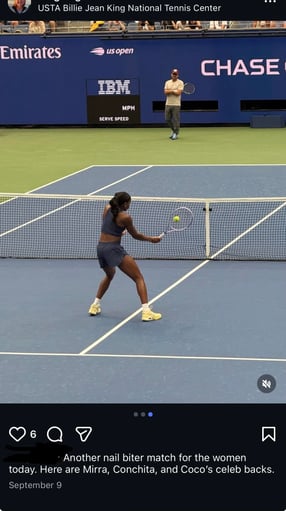
It’s a huge part of my Instagram account. It started in 2015 when I spotted Kevin Bacon leaving his apartment building on the Upper West Side. By the time I got my phone unlocked — this was pre-Face ID — he was halfway down the block. So I got a photo of his back. It kept happening with other celebrities, and I decided it’s actually better for privacy anyway.
At the Open, especially during Fan Week, it’s target-rich for me. I photograph the backs of players, coaches walking through the crowd, and my all-time favorites: two guys who show up every year dressed as 1970s Björn Borg and John McEnroe. And full circle — the morning of this interview, I ran into Kevin Bacon again in Central Park. Got his back.
What’s your all-time favorite live US Open moment?
Two come to mind. The first was during Fan Week years ago, when the Grandstand was practically empty — maybe me, a player’s mom, and a security guard. [Former U.S. Open finalist and longtime broadcaster] Pam Shriver was coaching a player during warmups and ended up standing right in front of me. I planted myself in the front row, because I could. I started talking to Pam, to her back. She was directly in front of me. She ignored me. I asked for one of the tennis balls she was holding. She shook her head no. I asked again. No. Third time, she turned around, smiled, handed it over — and signed it. I still have it. [EDITOR'S NOTE: See the top of this article for a photo of a triumphant Alison with her signed ball.]
The other is harder to pin down because I don’t remember who was playing, and that’s kind of the point. It was late at night on one of those tiny outer courts near the Grandstand — seating for maybe 20 people. The match was a nailbiter, and fans from adjacent courts were standing on chairs trying to see. You could hear cars on the expressway just over the hedges and ambulances whizzing by. The players were giving everything they had to qualify. Those moments — intimate, unpredictable, unmistakably New York — are why I keep coming back.
—
Have an NYC experience you want EDOers to give you the skinny on? Let us know. And don’t forget to sign up for our newsletter for all the latest TV ad insights.